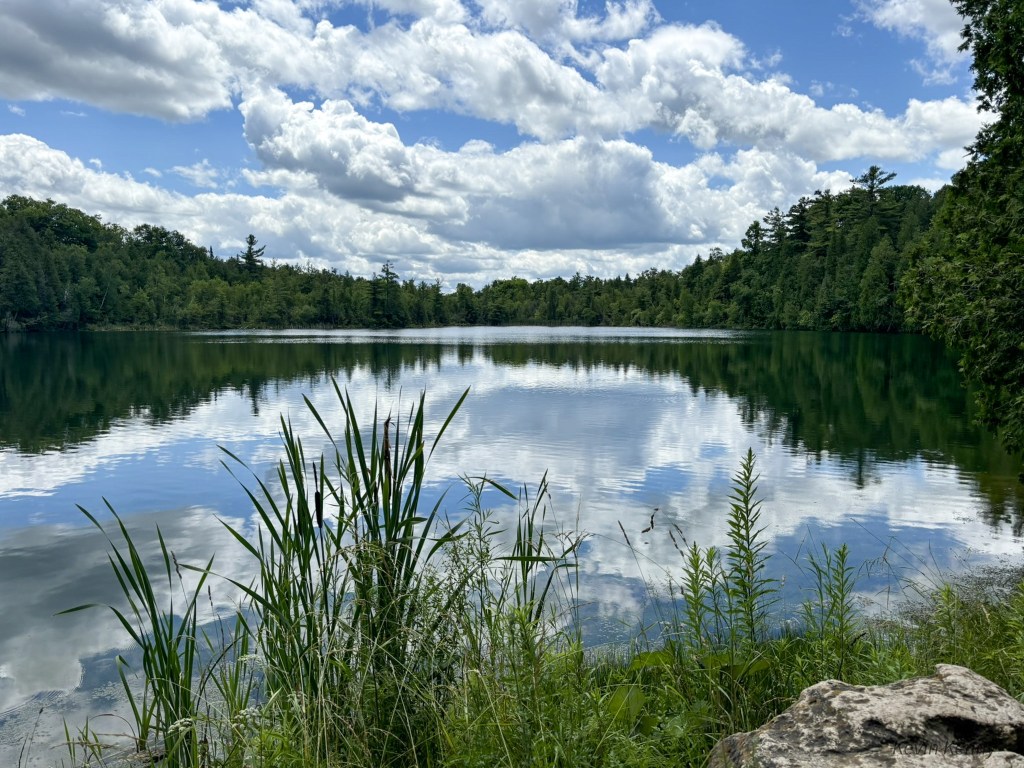
Archaeologists have uncovered ancient secrets from core samples beneath the lake’s surface where they have been brought into the light. Formed over 10,000 years ago this small freshwater lake reveals its secrets.
Visitors look out over Crawford Lake from a 900-meter-long wheelchair accessible boardwalk loop, weaving through tall cedar trees. Unseen are centuries of first nations people’s stories buried in the lake bed twenty-four meters below. At the surface, the landscape has remained much the same through recent generations. Cedar trees grow out from rock crevasses. Their roots cling to fissures big and small and each tree is struggling to survive against wind and time. A snapping turtle swims just below water level avoiding the perils of human contact. Occasionally its head pops up for a breath and a glance to gain its bearings. The land locked lake holds many fish species, three of which are: yellow perch, large mouth bass and bluegill. Native grasses grow tall on its banks. Overhead, a turkey vulture is silently scanning in search of fresh carrion. Each life here is in pursuit of sustenance.
Thirty-six in the world, twelve in Canada, eight in Ontario.
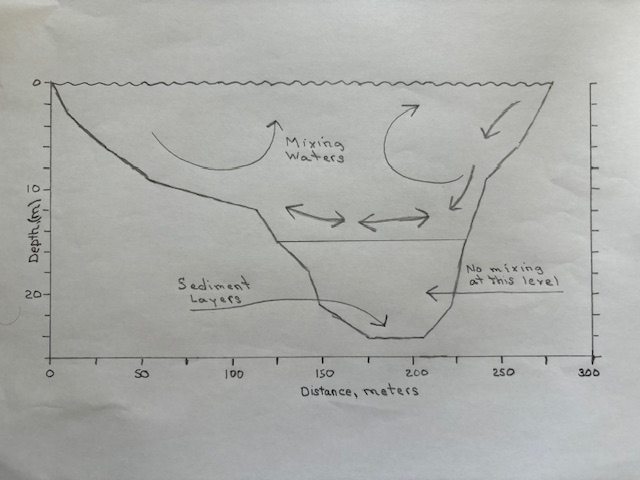
Crawford Lake is a rare meromictic lake preserving a wealth of undisturbed history at its depths. The lake is meromictic because it’s steep sided and is significantly deep in comparison to the lake’s surface area. In this type of lake, the top layer of water never mixes with the bottom layer. At the oxygen deprived, lifeless bottom, all matter is well preserved. Each spring, plant and tree pollen falls onto the water surface and eventually sinks to the bottom. For centuries, airborne pollen particles have created an annual marker tracking environmental events. Pollen layers are like tree rings in that they offer a snapshot of past climatic activities. In this case, a historical record has been kept for the tradition of indigenous story telling.
Discovery
During the late 1960’s and early 1970’s, researchers extracting core samples from the lake’s sediment layers discovered corn pollen. Corn pollen is an indicator of agricultural activity, which in this case was used to show the presence of the Attawandaron or Wendat Nations. Researchers also determined this to be the first examples of human impact on the lake and its surrounding landscape dating back to somewhere between the years 1200 and 1400. These were the late Middle Ages when The Great Famine and The Black Death swept across Europe. In later years, Columbus would sail to the Americas. First contact by the colonists had not yet occurred.
These findings brought about archaeological work in hopes of uncovering evidence of past Indigenous settlements near the lake. The result was the discovery of ten intricately crafted longhouses and more dating from the 15th century. Three replica long houses now stand on their original sites. The frames of two other longhouses have been erected by reconstruction crews on their original footprints. Unearthed fire pots were left positioned as they would have been when used for cooking and a means of warmth for clan members living inside these communal settings.
Pre contact village

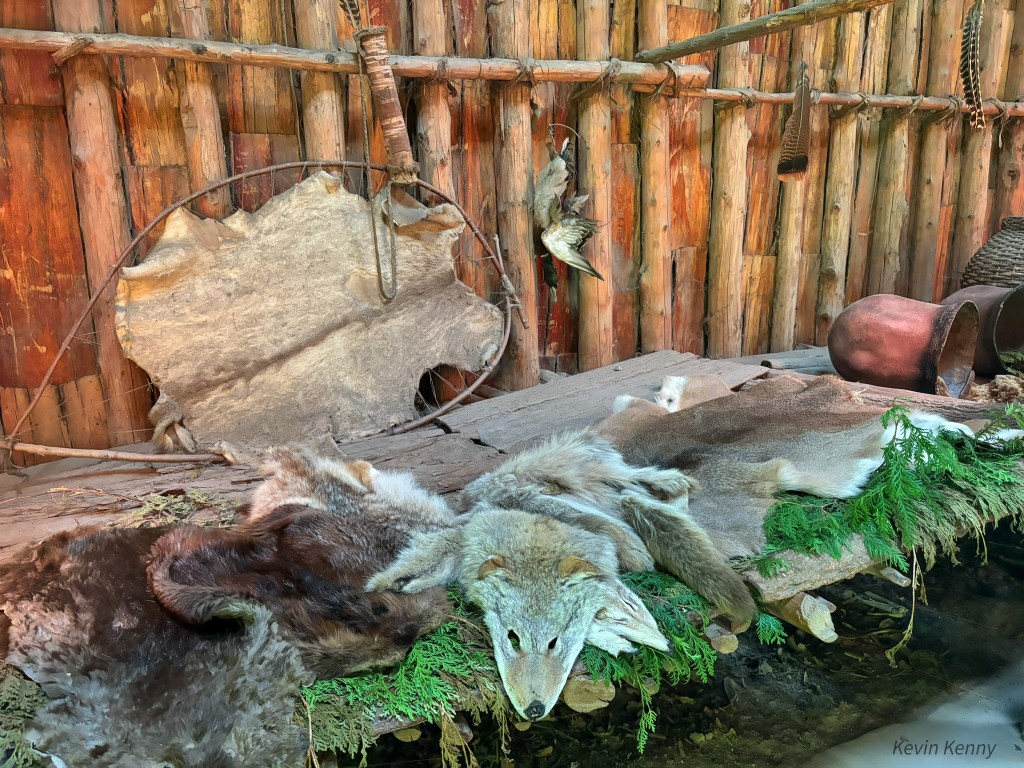
Upon entering a longhouse, your eyes need to adjust to the dimly lit space. Windows were not the standard we enjoy today. The only source of light is from doorways at either end and a ventilation opening at the roof. Flames from hearths also aid in providing lighting that would certainly be necessary at night.
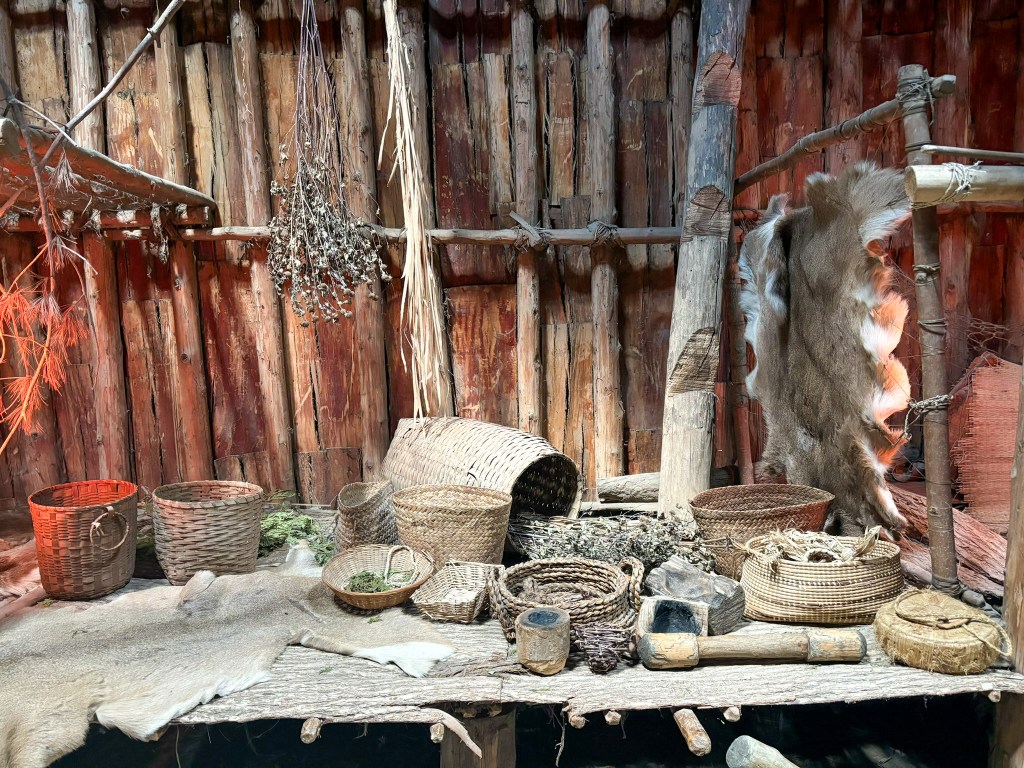
On average the replica longhouses are seven meters wide, with each one having different lengths of 24, 35 and 45 meters and they stand 5-metres high. The wood framed dome shaped structures are sheathed with thick layers of bark This is followed by a woven pattern of poles to firm up the outer covering of bark. Three-levels of racking line the two long walls. People kept to the lowest level for everyday living and rest. Tools, cooking utensils and other supplies were stored on the upper levels. Smoke from kindled fires rose up through a large vent in the roof. Clan members raised food up to the rafters where smoke kept both insects and rodents away. The houses are built tall to allow the level of smoke filling the longhouse to rise above the inhabitants, ensuring sufficient air to breathe.
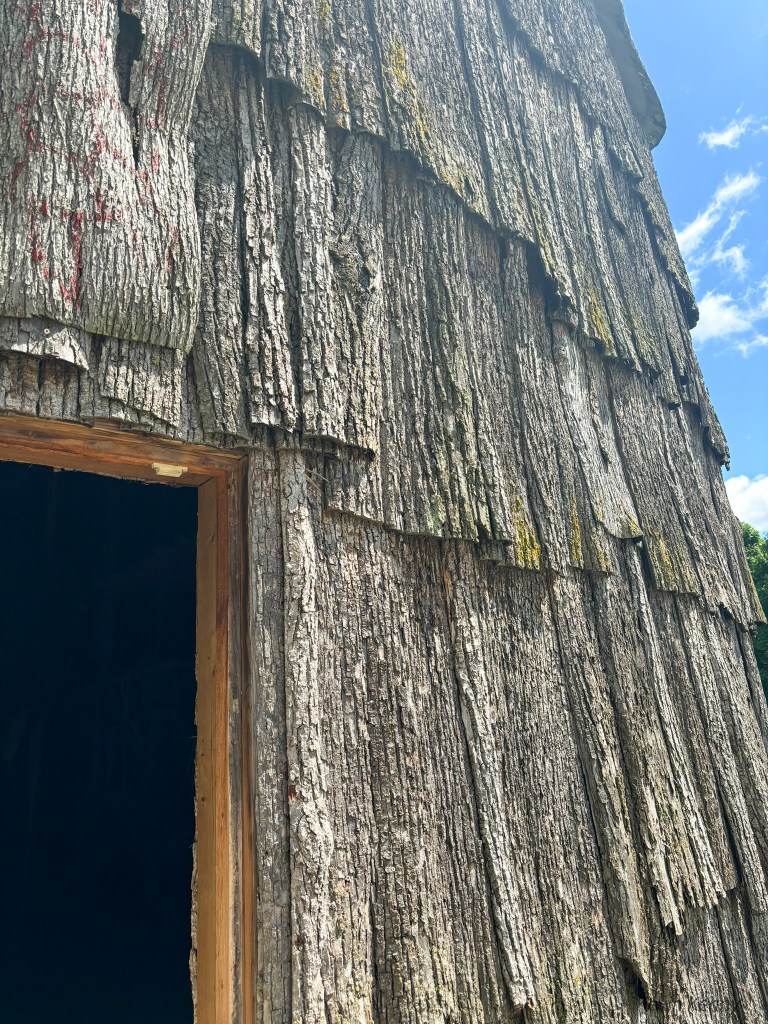
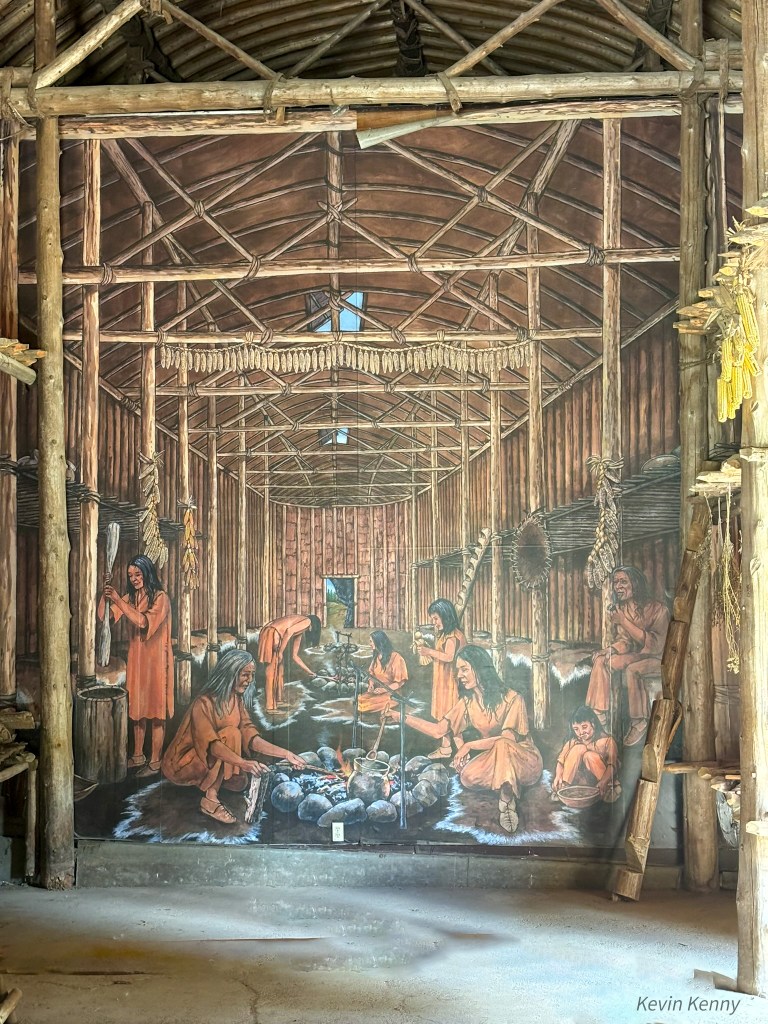
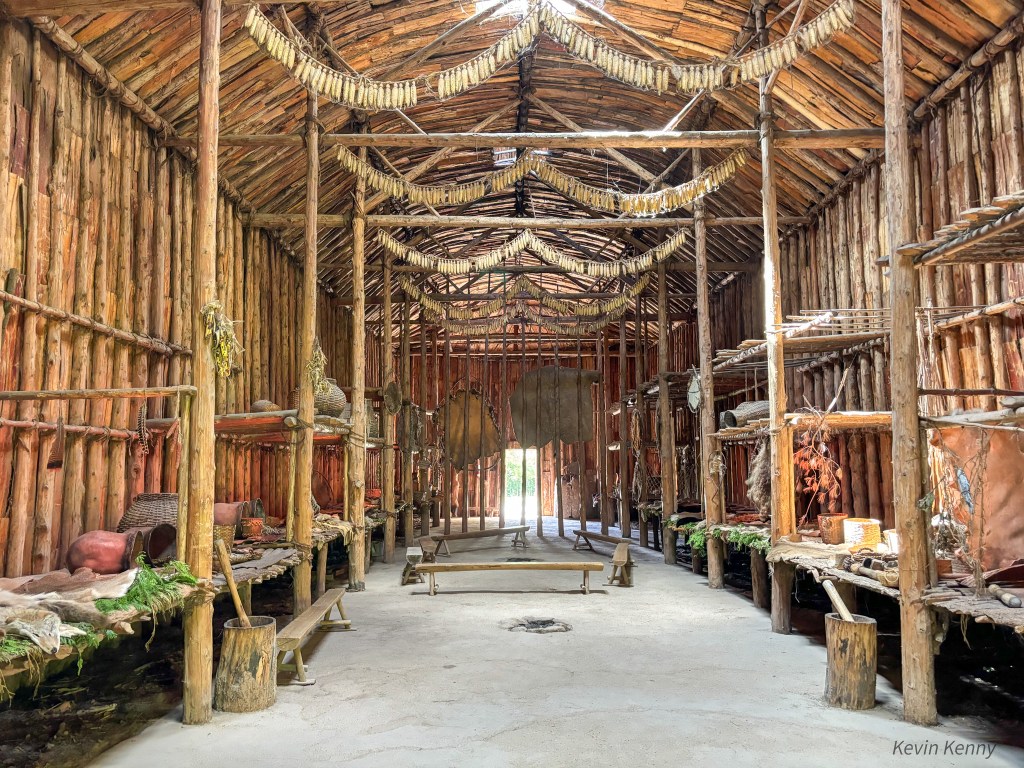
A palisade once surrounded the entire village to defend the community of approximately 450 individuals from intruders. Today, as an example, only a small section has been erected.

Food and warmth
Archaeological surveys found deer were the most important animals hunted. Yet, a variety of other mammals including elk, wolf, muskrat, and squirrel were also being used for food. Furs and skins were used for clothing and blankets. Bones and teeth were repurposed as tools and jewelry. No part of an animal went to waste. Organs and connective tissue all had a roll in daily life.
From Crawford Lake and other nearby water systems, catfish, pike, sucker, and lake sturgeon were the most predominant species fished. Others, including longnose gar, and drum were used for everyday tools like pins, needles, and hooks.
The forest offered a seasonal bounty of wild fruit like raspberries, elderberries, sumac, and hawthorn apples. The land provided greatly even though today we would quickly disregard those species as common weeds.
The Three Sisters
Lastly and most significant are the principal crops which were customarily grown by women of the village.
The “Three Sisters”, (corn, beans, and squash), were grown in great abundance. These crops played a key role in sustaining the entire village through tough times, but corn held a special place.
Not only was corn capable of being stored for years, but it also influenced the people’s history and culture. One example is the Harvest Festival celebrating the harvest with feasting, dancing, and giving thanks to the creator of successful crops.
Corn was often a means of survival in years of poor crop production due to seasonal weather conditions, pests, and diseases. Corn can also be credited for saving the life stories of the inhabitants of this village. Had corn pollen never been discovered within Crawford Lake’s sediment layers, these lives would have remained silent.
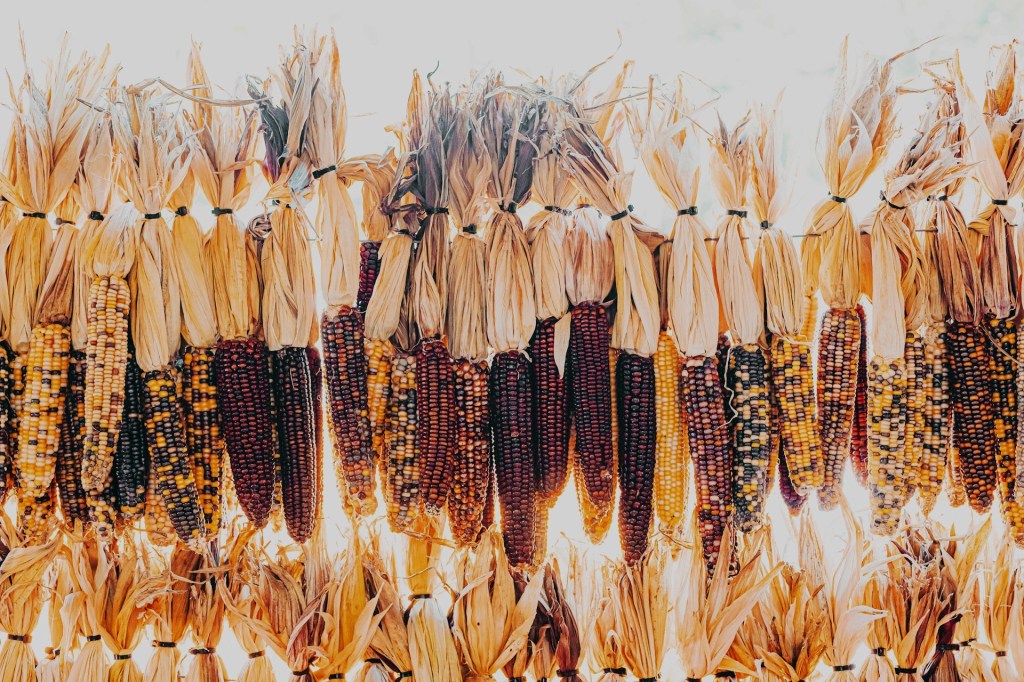
Photo by Sunira Moses on Unsplash
It Sustains Us
Land was never thought of as something to be owned, bought, or sold. Elder Harold Cardinal says: “The land, waters and all life‐giving forces in North America were, and are, an integral part of a sacred relationship with the Creator. The land and water could never be sold or given away by their Nations. The land is the pillar of who we are as Indigenous peoples. The land owns us. The land is our life giver. It sustains us.
Stories Treaty 3: Honouring its truths. Carlie Kane
Related post from Crawford Lake,
https://daytripinanhour.com/2019/10/26/nassagaweya-canyon-trail-in-milton/

 Day Trip Hour
Fascinating history, Kevin. The longhouses remind me of the Viking longhouses. I am intrigued also by the pallisade! Impressive way of keeping out intruders.
LikeLiked by 1 person
You may be onto something, Amanda. It might be that vikings did bring the concept of longhouse construction to North America. After all, historical evidence shows they here during the 10th century.
LikeLike
That is intriguing!
LikeLiked by 1 person
Thanks for commenting.
My research didn’t delve into particular types of corn. I can say corn seemed to have come from Central America. Mexico was often cited as a primary point of origin.
Enjoy your fresh corn. 🌽
LikeLike
We’ve been to Crawford Lake a couple of times, but haven’t seen the inside of the Longhouse. It’s nice to get a glimpse of it from your pictures and learn more about the history of the area. I’m thinking a return trip for us is in order!
LikeLiked by 1 person
I’ve seen some online sites indicating weekday guided tours are available. However, the information seemed a little vague.
Bring a lunch. There are plenty of picnic tables!
LikeLiked by 1 person
Fascinating. Why have we never heard of Crawford Lake? Thank you for introducing us to this interesting place and its history, Kevin.
LikeLiked by 1 person
Thanks, Jane.
Isn’t often the case where we become so accustomed to special places that we become blind to their importance.
LikeLiked by 1 person
Interesting! I didn’t know that some lakes didn’t experience fall turnover (mixing of upper and lower waters). Great post 😎
LikeLiked by 1 person
Thanks, Darryl. Surprising there are so few in the world.
LikeLike
Wow, this is fascinating, Kevin. I love your line, “Thirty-six in the world, twelve in Canada, eight in Ontario.” and I learned a new word – meromictic. So interesting. Thanks for taking us along!
LikeLiked by 1 person
Thanks Wynne, sometimes lines just roll off the tongue.
There’s another one a two drive away from me. I might visit it this year.
McGinnis Lake within the Petroglyphs Ontario Provincial Park. It too has an ingenious history.
LikeLike
Isn’t this wonderful!
LikeLiked by 1 person
There is much pre contact history we were not taught in school. I found myself going down many rabbit holes only to find myself scratching the surface.
LikeLiked by 1 person