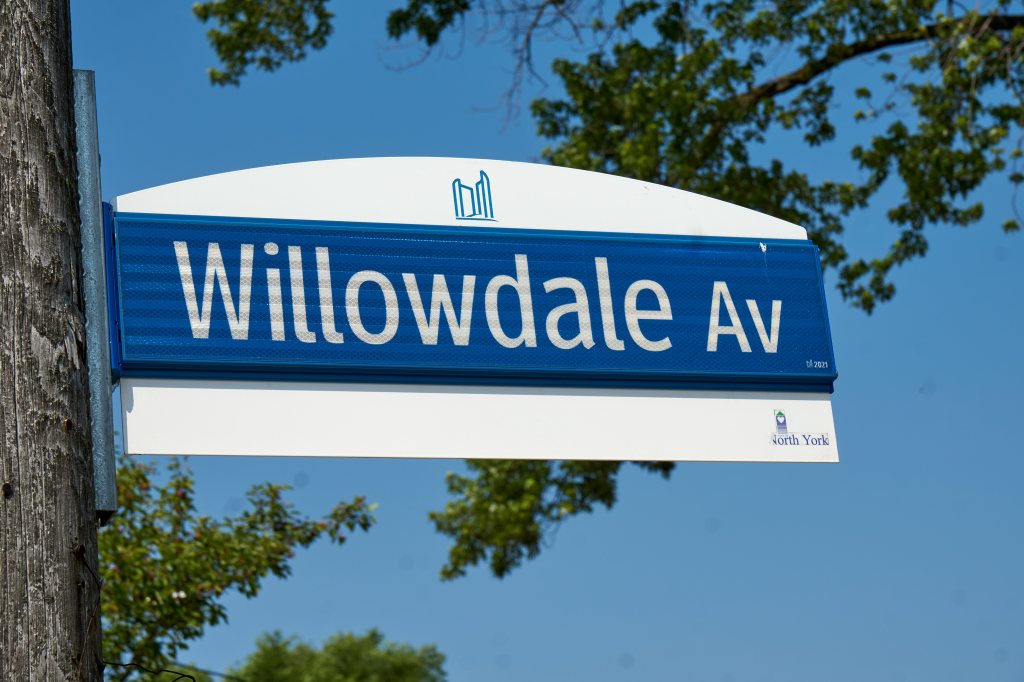
Thinking back to my earliest childhood memories, my circle of who and what I knew was close-by. I went to school, made friends and family was always by my side. My community was small; I lived inside an insulated border. Eventually, I grew older, moved away, and started a family. My boundaries of the familiar became wider. Is it not the same for villages, towns, and cities? Even they started from a tiny clearing in the woods.
Last month, I met up with James and Richard from Jane’s Walk as they led our group of 16 people on a historic walking tour through the neighbourhood of Willowdale, a suburb of Toronto. Some readers may know; Jane’s Walks are inspired by Jane Jacobs. (1916-2006).
Jane Jacobs
“She was a writer, urbanist, and activist who championed a community-based approach to city-building. She had no formal training as a planner, and yet her 1961 book, The Death and Life of Great American Cities, introduced ground-breaking ideas about how cities function, evolve, and fail that have become conceptual pillars for today’s architects, planners, policymakers, activists, and other city builders. Jacobs lived in New York City’s Greenwich Village until 1968 when she moved to Toronto, Canada. In both cities, she helped derail the car-centered approach to urban planning and invigorated neighborhood activism by helping to stop the expansion of expressways and roads.”
About Us – Jane’s Walk
Volunteers make a difference
The volunteer driven Jane’s Walk was founded in 2006 and today takes place in over 500 cities across the world, usually on the first weekend in May coinciding with Jane’s birthday on May 4th.
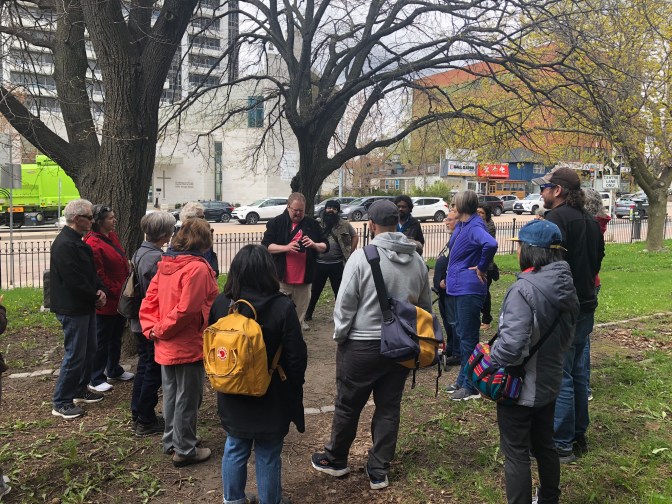
Gathered and ready for our Jane’s Walk tour.
We followed and listened to James and Richard as they told stories about the beginnings of Willowdale and how these lands were home to many of Canada’s First Nations Peoples. It would be a mistake to refer to the original inhabitants as a lost or ancient civilization. They are here today, in the present, and have been for over 11,000 years. The Huron-Wendat, the Haudenosaunee, the Chippewa, the Anishinaabe and the Mississaugas of the Credit called this place Tkaronto.
There was no Canada as we know it today. The territory was under British control and in 1887 the British bought 250,808 acres from the Aboriginal people of this region. The Toronto Purchase, officially known as Treaty 13 was revised and ratified in 1805. To this day, debates continue about the terms of the land transfer. From the time of the purchase no time was wasted in distributing these lands to European settlers.
Jacob Cummer
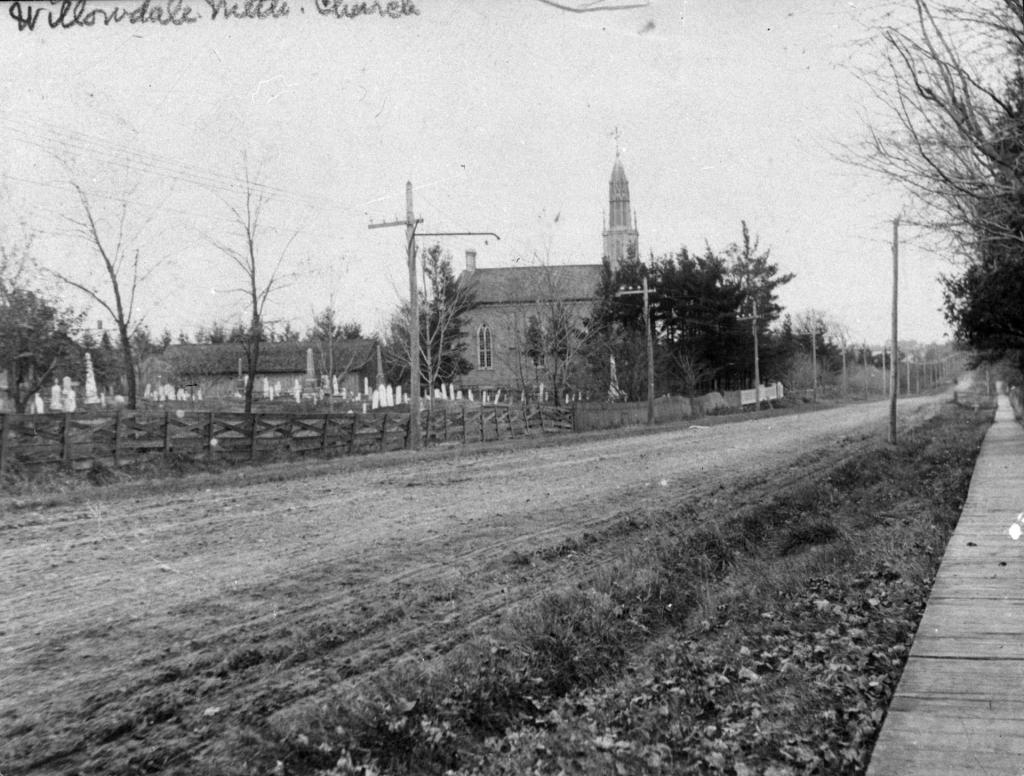
Land donated by Jacob Cummer for a chapel and an adjoining cemetery. In the foreground; looking south on Yonge Street. Photo credit: Toronto Public Library
In 1797, thirty-year-old Jacob Cummer was one of the earliest settlers arriving from Pennsylvania. He and his family were initially granted 198 acres to carve out from the wilderness a new home for themselves. I imagined them working the land with axes in hand; these very early years would not be easy. Wildlife may have been a plentiful food source, but also the new settlers were a food source for black bears, wolves, and cougars. Guidance from the skilled First Nations people would have been invaluable in setting up a foothold in this vast untamed new world.
Jacob Cummer’s many talents led him to be a sawmill owner on the nearby Don River. When the community needed medical aid, he taught himself to be the village doctor and veterinarian. As the population continued to grow, he donated land and built a chapel with an adjoining cemetery. The industrious Cummer became an influential community leader and was honoured by having this new district named Cummers Settlement. The street leading to his sawmill was called Cummer Avenue and still bears his name to this day.
Cummer was originally spelled with a (K) Kummer
As James and Richard guided us along the city sidewalks, sounds from car engines and the occasional ear-piercing fire truck siren making emergency runs on smooth paved streets sometimes made it difficult to hear their voices. I thought of some of the sounds people may have heard arriving here on their first day. Sounds of horses clopping as they pulled pioneer wagons across dirt roads. Men with a two handled log saw cutting down virgin timber, ripping back and forth until the tree fell. Settlers voicing their opinion about plans for the future. Our next stop featured the person put in charge of making the journey from A to B a little easier.
David Gibson

Proclamation for the arrest of David Gibson and his fellow rebels. Photo credit: Toronto Public Library
Before 1763, this region was under French rule. It then came under British control after negotiations with France and was later named Upper Canada in 1791. The new government of Upper Canada needed to gain a better understanding of the topography of the land it had gained and wanted to create plans for road developments.
David Gibson, a land surveyor from Scotland was just the person for the job, but his political aspirations led him to be involved in a political insurrection.
William Lyon Mackenzie, a prominent political figure wanted Upper Canada to be a democracy. He argued Upper Canada must not be influenced and controlled by British autocratic rule. One incident of rebellion against the ruling government resulted in Mackenzie sympathizers being jailed.
A small number of Mackenzie supporters including David Gibson gathered at Gibson’s Willowdale farm property in December of 1837 in preparation for a raid against their British overlords. The armed Gibson troops looked to protect prisoners held at Montgomery’s Tavern, which had been seized and repurposed as a jail. Gibson’s men made their way to the tavern and after a brief clash, resulting in no deaths, 54 prisoners were freed and led to their safety.
There were other and much graver clashes during the almost year long rebellion however, the entire event was later regarded as unnecessary. Changes to the governing system were already underway but despite this, David Gibson suffered consequences for his participation. His farm in Willowdale was burned to the ground and assets seized. Gibson, with a bounty on his head was now on the run and fled to nearby Oshawa where he hid inside a hay barn for a month. He continued to evade capture by crossing Lake Ontario to New York. In 1843 he was pardoned by a new sympathetic government but didn’t return until 1848. Upon his return, he was reinstated as land surveyor for Upper Canada. His political career flourished as did his new businesses resulting in greater personal wealth.
The rebellions were the inevitable result of an undemocratic colonial system
Fire Station # 1
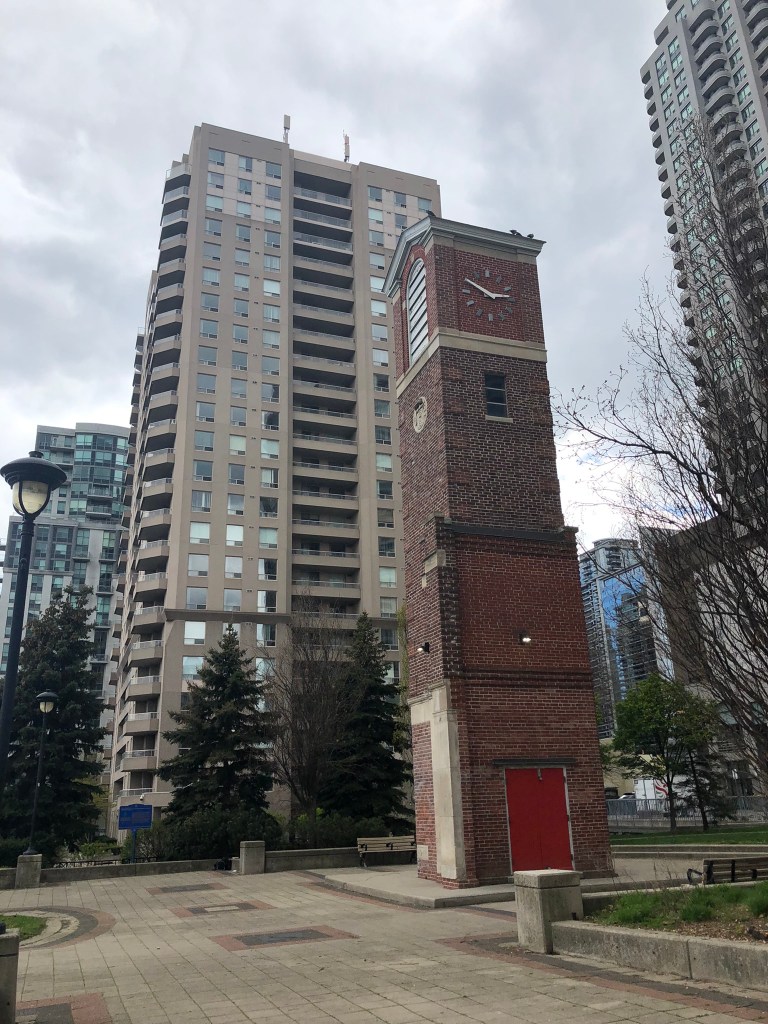
Reconstructed hose tower from Willowdale’s fire station #1.
In 1922, the community decided to buy its first-ever fire truck, a converted Ford model T car. The sturdy car was affordable and easy to use by 24 volunteer firefighters who had no formal training. It had a hand-rung bell, a hand-cranked siren, two 95 litre water tanks, a hose, a ladder and an axe. Jack Nelson was selected as fire chief. According to folklore, the fire truck was so slow that bicyclists easily passed it.
Like father, like son
At age 14, Ivan Nelson started as a volunteer firefighter honing his skills while riding along with his father, Jack. In 1935, at age 22, he was instated as the youngest fire chief. Ivan was kept busy 24/7 with three phone lines at his apartment. His wife managed the phones during emergencies, calling on volunteers, and touching base with water and power utilities.
In 1941 a full-time fire department was created with Ivan serving as chief. Fire station # 1 was built in 1942 with two bays and as the population base grew a third bay was added in 1952. At the time the fire hall was built, it was the first fire station in Willowdale crewed by full time professional fire-fighters, supported by several volunteers.
Originally at 5125 Yonge Street, it was razed after 47 years of operation to make room for redevelopment. The three bays and adjacent structures were not saved. The hose tower is all that remains of Willowdale’s fire station #1. The hose tower was carefully taken down and reconstructed in Princess Park at 214 Doris Avenue.
The Willow Movie Theatre
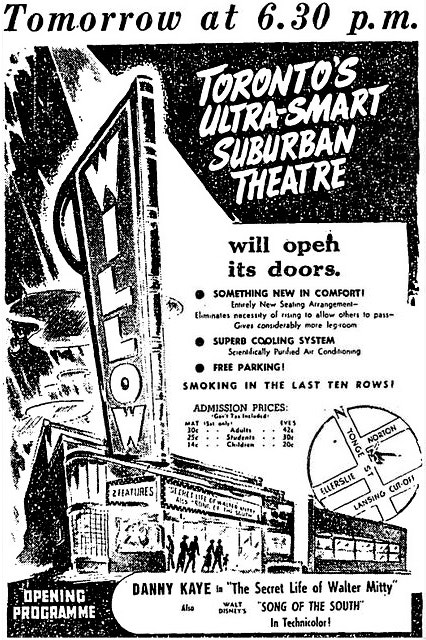
An ad from a local newspaper featuring the Willow Theatre for its grand opening movie. Photo credit: Toronto Public Library
The Willow theatre was a single screen, 300 seat venue at 5255 Yonge Street. The grand opening feature was presented in “Technicolor” on June 18th, 1948. The Secret Life of Walter Mitty starring Danny Kay had movie goers lining up around the block.
For decades, parents brought their movie obsessed kids to the Willow’s front door to be transported to another place as the moving pictures flickered before their eyes. They gathered with friends experiencing joy, sadness, and insight into worlds beyond Willowdale’s borders during their formative years.
Sometimes kids took less than ideal messages from the movies.
In March 1957 stink-bombs were set off for three weeks on Friday nights resulting in the audience running out from the theatre until the rancid odor was cleared. The police finally arrested a 17-year-old boy, putting a stop to his unpleasant undertakings.
In 1958, there was an absolute uproar. The theatre played back-to-back titillating movies, “And God Created Woman” with “sex kitten” Brigitte Bardot, and “Peyton Place” starring pin up girl, Lana Turner. The Legion of Decency objected to the showing on the grounds of offensive indecency counter to Christian morality.
The Willow was demolished in 1987 to make way for yet another condominium development. Subdivisions and geometric buildings continued to sprawl towards unlit skies. The charm of old replaced by shopping malls and concrete walls. We’re in a rush to start new dreams to somewhere.
Rush
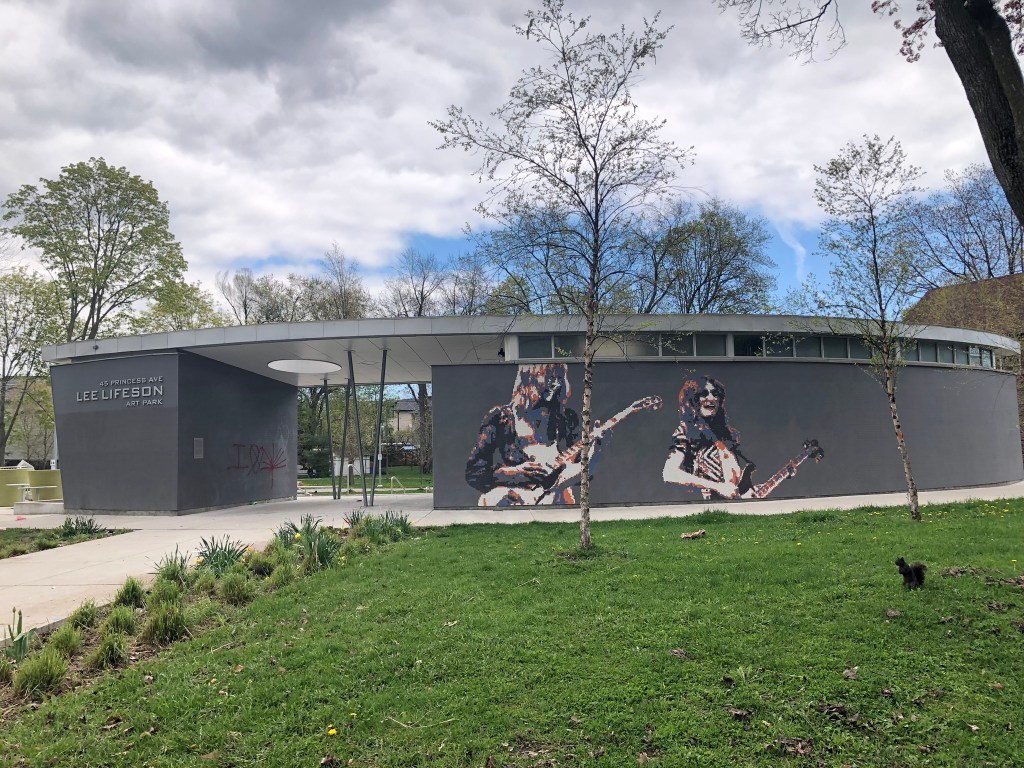
Lee Lifeson Art Park
A highly devoted male fan base
If my last words somehow sound vaguely familiar, you’re right. They’re lyrics sung by Geddy Lee, Neil Peart and Alex Lifeson from the progressive rock band, Rush. Formed in Willowdale in August of 1968, the band has been inducted into the Rock and Roll Hall of Fame, obtained a star on The Hollywood Walk of Fame, and has received The Order of Canada. Willowdale’s growing suburban neighbourhood partially inspired the band’s 1982 anti-suburbia anthem “Subdivisions.” In recognition of the band’s achievements, Lee Lifeson Art Park was opened in September 2016 giving credit to the two band members from Willowdale. No disregard was directed towards Neil Peart, it’s just that he grew up in St. Catherines, Ontario.
Three developer owned homes were taken down to make room for the 7,000 square metre Lee Lifeson Art Park. Isn’t that some kind of karma after many of Willowdale’s historical landmarks were demolished? The park features music-themed installations, a small amphitheater stage to give up-and-coming artists a place to play and a large pavilion bearing the likenesses of Lee and Lifeson.
Richard pulled a sheet of paper out from his shirt pocket and like a poetic rock star, he read out loudly the lyrics to Rush’s Subdivision. James played on his imaginary air guitar, and we followed on air drums. Ok, the imaginary air instruments didn’t really happen, but wouldn’t it have been a cool ending to our tour.

 Day Trip Hour
Fascinating history of Willowdale, much of it was new to me as were the characters involved. Jane Jacob’s is the only one I knew of. Thanks for this.
LikeLiked by 1 person
This was terrific, Kevin. Thanks so much for this tour of Willowdale’s – and Canada’s – rich history.
LikeLiked by 1 person
Thanks for dropping by, Jane. When standing in the middle of big cities it’s hard to imagine our humble beginnings.
LikeLiked by 1 person